Tyre Pressures for Overlanding: What to Run and Why | OVRLNDR
But managing tyre pressures isn't just "air down for off-road, air up for tar." There's more nuance to it than that and getting it wrong can cost you a sidewall, a rim, or worse, a rollover on soft sand. Here's what we've learned and what we actually run.
Most people who air down for the first time have a bit of a moment. You drop 10–15 PSI, drive the same rocky track you were crawling over five minutes ago, and wonder why you didn't start doing this years ago. The rig feels planted, the noise drops, and you stop white-knuckling the steering wheel.
But managing tyre pressures isn't just "air down for off-road, air up for tar." There's more nuance to it than that and getting it wrong can cost you a sidewall, a rim, or worse, a rollover on soft sand. Here's what we've learned and what we actually run.
Why Tyre Pressure Matters More Than You Think
Your tyres are the only thing between your rig and the ground. Everything else, suspension, diff locks, traction control, is just helping you manage what the tyres are doing.
Higher pressure keeps the tyre rigid, which is exactly what you want at highway speeds. The contact patch is smaller and centred, rolling resistance is low, and your fuel economy stays reasonable.
Lower pressure spreads the tyre out. The contact patch gets longer, you float better on soft surfaces, and the tyre can flex over and around obstacles instead of bouncing off them. On a rocky 4x4 track, that flex is what stops you ripping a sidewall on a sharp edge.
The catch: go too low and you risk the tyre debeading off the rim. Go too high in soft sand or on corrugated dirt and you're losing traction and beating your rig apart with every washboard. Neither is a fun situation to be in 80km from the nearest assist.
A Starting Point: Terrain-Based Pressure Guide
Everyone's rig is different — tyre size, vehicle weight, load, and tyre brand all play a role. So rather than giving you a PSI number that may be completely wrong for your setup, we work in percentages of your normal road pressure. Find your on-road number (check the sticker in your door jamb or your owner's manual, not the sidewall), and use that as your baseline.
Here's our practical starting point:
| Terrain | Recommended Pressure | Notes |
|---|---|---|
| Tar / highway | 100% (your normal road pressure) | Don't drop here. Ever. |
| Gravel / dirt road | 80–85% | Helps with corrugations, minor comfort improvement |
| Rocky or technical 4x4 track | 65–75% | Flex matters here - tyre wraps obstacles rather than bouncing |
| Sand / dunes | 50–65% | Bigger footprint, float over soft surface — essential |
| Deep mud | 60–70% | Lower pressure helps, but tread pattern matters more here |
A few important caveats:
- These are starting points, not gospel. A lightly loaded Jimny and a fully laden Land Cruiser 79 series bakkie aren't running the same pressures.
- Always air back up before you get back on tar. Every time. No exceptions.
- If your tyres are showing signs of rolling under load at lower pressures, you've gone too low.
- On sand, go lower than you think you need to. The number of people we've seen stuck in the Kgalagadi or on the Namaqua coast because they didn't air down enough is a lot.
Speed Changes Everything
This is the bit people miss. Lower pressure at speed is dangerous. A tyre running at 65% pressure on tar at 100km/h builds heat fast, handles badly, and can fail. If you've dropped pressure for a section of the trip and you're jumping back on tar, even briefly, even "just for a few clicks", air back up first.
The rule we use: if you're doing more than about 60–70km/h for any meaningful stretch, you should be close to your road pressure.
Tyre Type: A Quick Note
Your tyre type does affect how you approach pressure, not dramatically, but it's worth knowing.
All-Terrain (AT) tyres are the most forgiving to air down. They're designed to flex, and the sidewalls are generally beefy enough to handle reduced pressure without rolling under load. Most overlanders running a well-chosen AT will work well with the percentages above.
Mud-Terrain (MT) tyres typically have stiffer sidewalls and more aggressive tread blocks. They can handle a bit more abuse at lower pressures but are also less forgiving if you go too low. That stiff sidewall doesn't warn you the same way an AT does before it starts rolling.
Light Truck (LT) vs Passenger (P-metric) tyres is where it gets interesting. If your rig came with P-metric (passenger) spec tyres from the factory and you've loaded it up with a canopy, fridge, water, camping kit, and a family, you're overloading those tyres. LT-spec tyres are built for higher loads and generally have tougher construction throughout. This matters a lot when you start airing down because an overloaded P-metric tyre running low pressure on a technical track is a recipe for a debeading or a blowout.
We'll do a dedicated post on tyre types, AT vs MT, LT vs P-metric, and how to choose, because it's worth the full breakdown. But from a pressure standpoint: know your tyre spec, know your load, and don't push either beyond their limits.
Get a Tyre Pressure Monitor - Seriously
Hand on heart, a tyre pressure monitor system (TPMS) is one of the most underrated bits of kit you can have on a trip. Not because it does anything fancy, but because it watches your pressures in real time while you're focused on driving.
We are big fans of the Ngauge TPMS system as it connects to a simple app on your phone.
A slow leak on a back tyre in soft sand? You might not feel it until you're flat. A TPMS will alert you before that becomes a recovery situation.
The good news: you don't need an expensive setup to get real value from one. There are solid systems available locally for under R1,500. Some of the better budget options are wireless, run on the existing valve stems, and display on a small screen you can mount on your dash. You're not looking for a Bluetooth-integrated 10-inch display unit. Just something that tells you what your pressures are doing while you drive.
The non-negotiables in a budget TPMS:
- External valve-stem sensors (easier to install, widely available)
- Real-time pressure and temperature display
- Audible low-pressure alarm
- Battery life of at least a full trip
If you're running a trailer or caravan, look for a unit with 6-sensor capability. Some systems support up to 10 sensors, which covers your trailer tyres as well.
Don't make it complicated. The best TPMS is one you actually use. Buy something affordable, fit it, and check it every time you set off.
The Kit That Makes It All Work
If you're serious about airing down properly, you need two things alongside your TPMS:
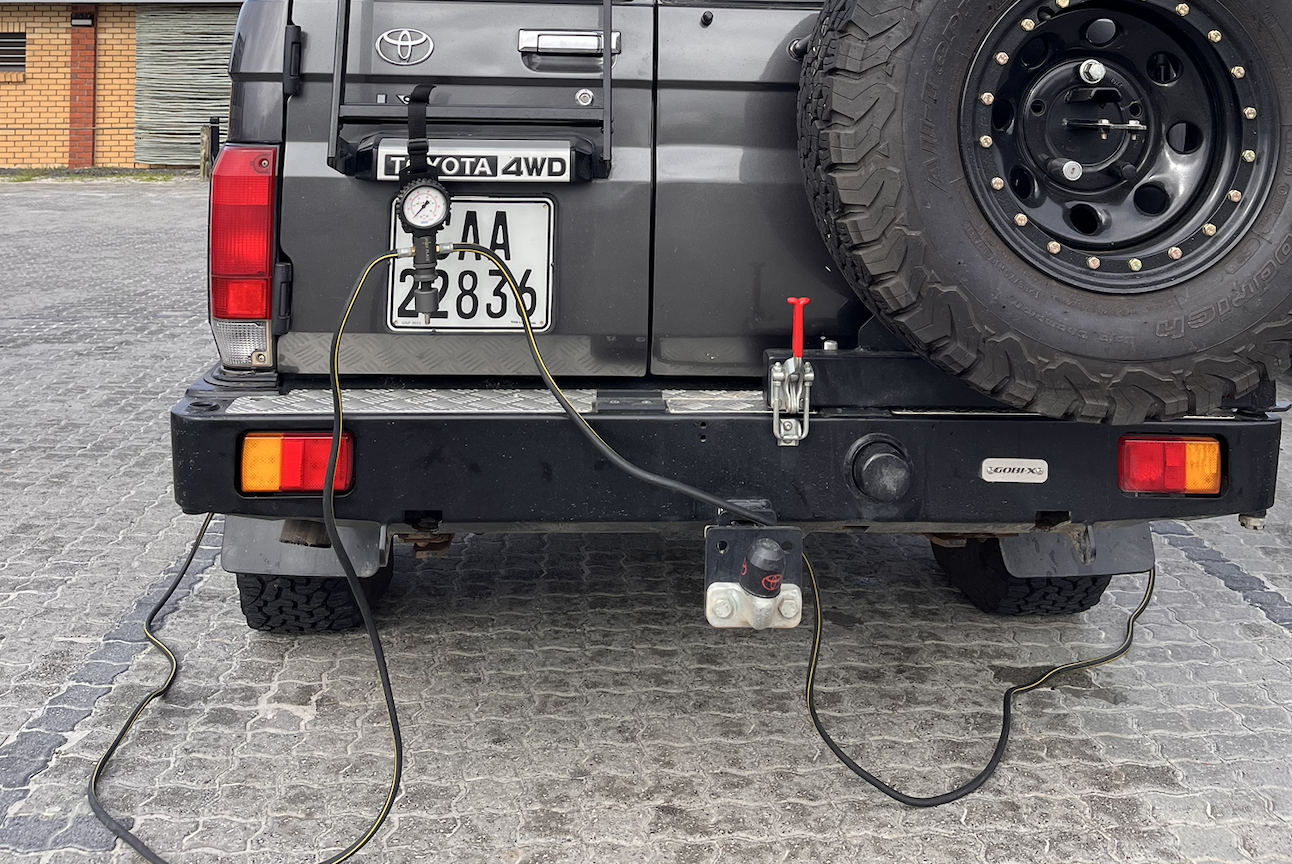
A reliable deflator - the cheapest deflators are slow and frustrating. A quality threaded deflator gets you to your target pressure in a fraction of the time. Worth it.
A decent compressor - you will need to air back up. Every trip. A portable 12V compressor is essential kit. Size it for your tyres. A small compressor struggling to inflate a 285/75R16 is a slow, hot experience. Check the CFM rating, not just the max PSI.
Both of these, along with a fair bit of other second-hand overland gear, come through the OVRLNDR marketplace regularly. Worth checking before you buy new.
Our Take
Tyre pressure is one of those things that looks simple but has a real impact on your trip comfort, your fuel bill, your tyre lifespan, and at the extreme end, your safety. The habit of airing down for off-road, airing up for tar, and keeping an eye on your pressures with a TPMS costs you almost nothing and gives you a lot back.
Start with the percentages above, adjust for your specific rig and load, and don't go out on your first sand trip without a TPMS fitted and a compressor in the back.
What do you run? Drop your pressures and your tyre combo in the comments. Always useful to compare notes with rigs in similar setups. And if you've got a pressure tip that's saved your trip, we want to hear it.