The Best Awnings for Overlanding in Southern Africa
A complete guide to choosing an awning for overlanding in Southern Africa, covering the main types, weight, ease of use, and brand-by-brand comparisons including Alu-Cab, Ironman, Eezi-Awn, Front Runner, Bush Company, Bundutec and Tentco.
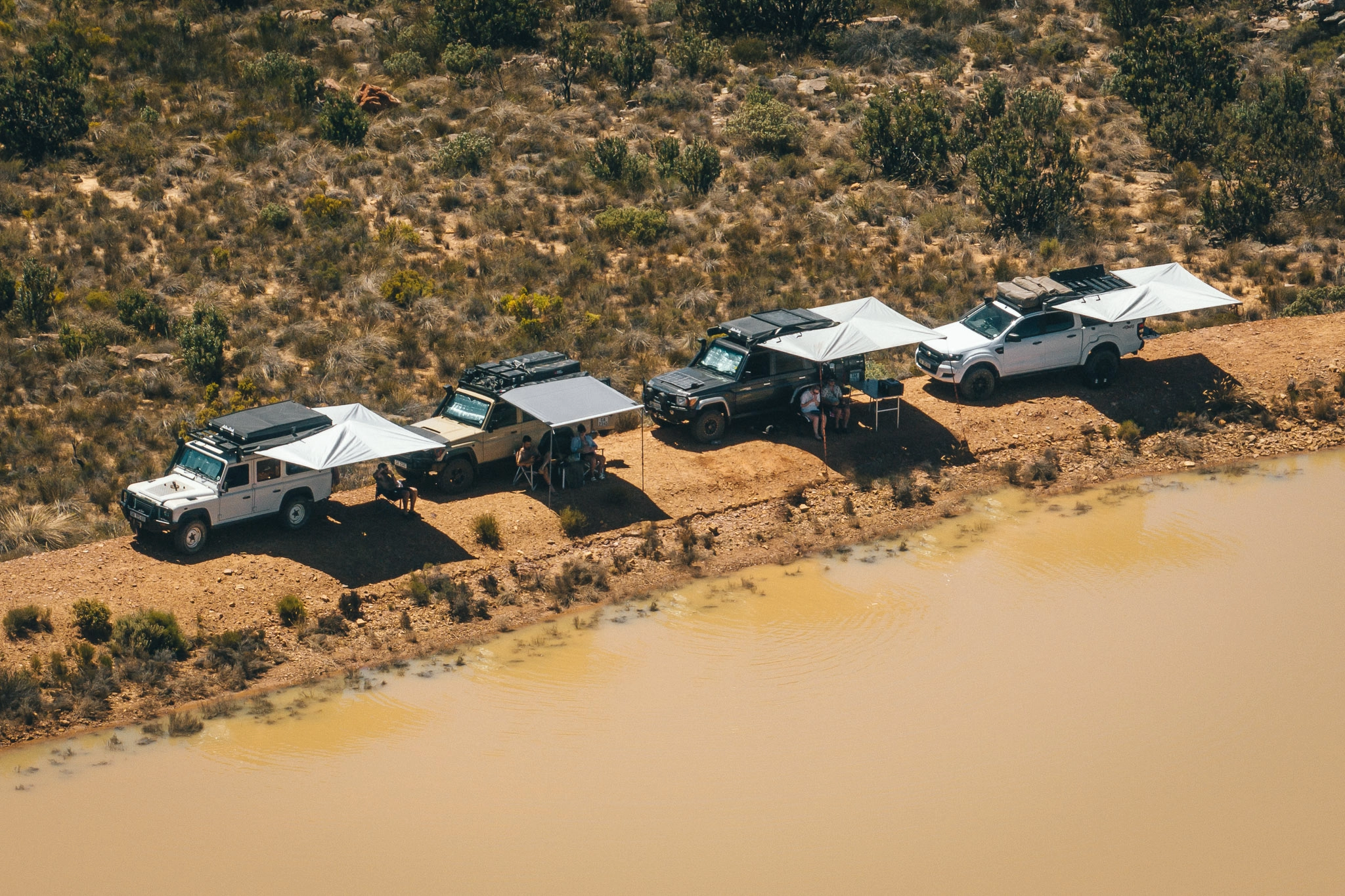
There's a moment on every trip where your awning either earns its money or doesn't. Usually around 14:00 somewhere in the Kalahari, when the shade under the vehicle has shrunk to a stripe, the fridge is working overtime, and nobody wants to stand up. That's when you find out whether you bought the right one.
Awnings are one of those mods people buy twice. First the cheap one, then the one they should have bought. So before you spend anything, it's worth getting clear on the actual choice in front of you: a 270 that swings around the back of your rig, or a pull-out that comes off the side.
Start with how you actually camp
This is the question that decides everything else, and most people skip it.
If you move every day, if you're doing Cape Town to Kgalagadi with a night here and a night there, you're setting up and packing down constantly. Speed and solo operation matter more than square metres. You want something you can deploy at a roadside stop for a 20 minute lunch without thinking about it.
If you basecamp, if you find a spot in the Cederberg and sit there for four nights, you're setting up once. A bit more faff on day one is fine. Coverage, wind stability and the ability to add walls matter more.
And be honest about who's with you. A couple with two camp chairs and a Cadac needs a very different footprint to a family of five with a kitchen, a wash-up station and somewhere for the kids to get out of the sun.
Pull-out awnings: the honest workhorse
A pull-out (also called a roll-out or bag awning) mounts to the side of your rack, unzips, and pulls out over telescopic legs. One rectangle of shade down one side of the vehicle.
What they're good at: they're light, they're cheap, and they don't dominate your roof rack budget. A Front Runner Easy-Out 2m is 12.5kg. A Tentco 2m x 2m is 12kg. Compare that to 24kg or 28kg for a 270 and you've freed up real payload for water, fuel or a decent drawer system.
What they're not good at: setup. Every pull-out involves legs, guy ropes and pegs, and most manufacturers themselves describe it as a two-person job. In wind it's genuinely annoying. And you get shade on one side only, which means the working area at the back of your bakkie (fridge, drawers, tailgate) is still in the sun.
Who it's for: weekend campers, budget builds, anyone with a payload problem, and anyone who honestly only uses an awning a handful of times a year. There is zero shame in this. A R3,200 Tentco that gets used properly beats a R20,000 awning that lives in the bag.
270 awnings: the one you don't think about
A 270 mounts on one side and swings through 270 degrees, wrapping the side and the rear of the vehicle. Most of the good ones are freestanding, meaning no poles in normal conditions. Unzip, swing, done, usually in under a minute and usually solo.
What they're good at: the rear coverage is the whole point. Your fridge, your drawers, your kitchen and your chairs all end up under canvas at the same time. The freestanding designs make you dramatically more likely to actually deploy it, because a 45 second setup with no pegs is worth doing for a lunch stop. That is the real-world difference, not the spec sheet.
What they're not good at: weight and money. You're looking at 20kg to 33kg hanging off one side of your roof, and R15,000 to R20,000 before brackets. Some of them are also long enough (2.3m to 2.6m closed) that fitment on a shorter rack gets fiddly.
Who it's for: anyone travelling more than a couple of weeks a year, anyone who cooks properly at camp, and anyone doing hot, exposed country like the Richtersveld, Kgalagadi or the Botswana pans.
Weight: the number people ignore until it's too late
This is where SA overlanding gets real. A 270 awning is 20kg to 33kg mounted high, on one side, well outside your centre of gravity. On corrugations (and if you've done the Nossob road you know) that mass is being shaken thousands of times an hour, working on your rack mounts and your rack itself.
Check three things before you buy:
- Your roof rack's dynamic load rating, not just the static one. The awning plus a rooftop tent plus a spare eats most racks' dynamic capacity fast.
- Your rack length. Bush Company, for example, specify that the 270 XT MAX shouldn't go on a rack shorter than 1.9m.
- Your GVM headroom. 30kg on the roof is 30kg you can't put in the back, and the roof is the worst place to carry it.
A 13kg pull-out is a genuinely different vehicle to live with than a 33kg 270. That's not a knock on the 270, it's just the trade.
Alu-Cab 270° Shadow Awning
Made in: South Africa (Cape Town)
Type: 270°, freestanding, no poles for standard setup
Weight: 24kg (2.6m) or 18.5kg (2m)
Shade: 10m² (2.6m) or 6.1m² (2m)
Approx price: around R16,000 for the 2.6m, awning only
The one that made 270s mainstream in this country. Built in the Cape, which means it was designed by people who have had an awning try to leave in a south-easter. Four aluminium arms, a drop-down brace on the centre arm, tie-down straps on each arm, and reflective ripstop canvas that noticeably drops the temperature underneath rather than just blocking light. Alu-Cab quote 45 seconds to deploy.
The 2m version is worth knowing about. At 18.5kg it's a serious weight saving over the 2.6m, and 6.1m² is still plenty for two people. If you're on a Jimny or a shorter rack, start there.
Chris's take: I wasn't even shopping for an awning. I bought a second hand Alu-Cab rooftop tent and the 270 came as part of the package deal. All I can say is: gamechanger. I'd run a Tentco pull-out before that (nothing wrong with it, it's simple, cheap and does exactly what it's intended to do), but moving to something one person can swing out and pack away made a huge difference to our camp setup. It's easily one of the most used pieces of kit we have and the first thing out when we arrive at camp. Build quality has impressed me too: hot weather, relatively strong wind, rain, it's held up really well. The bit I didn't expect is how diverse it is. Because it's permanently mounted to the car, it gets used at the beach, at roadside stops en route to camp, on a Sunday drive. It stopped being camping kit and became everyday kit.
Best for: people who want the benchmark and don't want to think about it again.
Ironman 4x4 DeltaWing 270
Made in: Australian brand, sold and supported locally
Type: 270°, freestanding, with swing-down support poles for bad weather
Weight: 28.15kg (including brackets and accessories)
Length (closed): 2.4m on Craig's unit
Material: 320gsm poly-cotton canvas with blackout coating, powder-coated aluminium frame and pivot brackets
Shade: 10m²
Approx price: around R15,500 (LHS)
Ironman's play here is value plus features. The DeltaWing comes with integrated LED lighting running the length of the arms (magnetic connectors, USB powered, three dimming modes), a centre rain pole that forms a drainage valley instead of letting water pool, and blackout-coated canvas that cuts heat rather than just light. Eight guy ropes and pegs are in the box, and it's backed by a three year manufacturing warranty.
The LED integration sounds like a gimmick until you've camped without it. One less thing to pack, one less cable, one less thing to hang.
Craig's take: I've been running the DeltaWing since November 2025 and it has genuinely impressed me. Harsh sun, heavy rain, strong wind: the build quality, sturdiness and overall design have stood up exceptionally well. When the wind really picks up, the extra support legs and guy ropes give you the confidence to keep it securely tied down. The 270 design is a must for me, significantly more shade and coverage than a traditional 180, while still being easy enough to set up on my own. At 2.4m it's slightly shorter than some options on the market, but I've never found myself wanting for more coverage, and it stays remarkably cool underneath. I also really like the annex, which effectively creates another room below the rooftop tent. That's particularly useful when my wife and daughter are upstairs and I'm sleeping downstairs with the doggo. My favourite feature though has to be the built-in tri-colour dimmable LED lighting. The power connection using individual cables can be a little fiddly, but once it's set up, the lights are an absolute game-changer and something I now wouldn't want to camp without.
Best for: people who want 270 coverage with the extras built in, at the lower end of 270 money.
Eezi-Awn Bat 270
Made in: South Africa (Johannesburg)
Type: 270°, freestanding in calm conditions, with height-adjustable legs on three of four arms
Weight: 21kg
Shade: roughly 7.4m²
Approx price: R16,260 for the Bat 270, R17,450 for the Bat 270 Xtreme
Eezi-Awn have been doing this for four decades and it shows. At 21kg the Bat 270 is one of the lighter proper 270s on the market, and the poly-cotton ripstop canvas is the same family of material as their tents. Real canvas rather than a plastic-based fabric, which matters over years of SA UV.
The adjustable legs are a genuine advantage on uneven ground, where a fully freestanding awning can end up sitting wrong. Eezi-Awn themselves recommend pegging the legs in an X pattern as standard practice, which is a refreshingly honest bit of manufacturer copy.
Best for: the weight-conscious buyer who wants canvas, not synthetic, and doesn't mind putting legs down.
The Bush Company 270 XT and 270 XT MAX
Made in: South Africa (Australian brand, local manufacture)
Type: 270°, freestanding, no poles or guy ropes required
Weight: 27.8kg (270 XT), 33.5kg (270 XT MAX)
Shade: 8m² (XT), around 12m² (XT MAX)
Approx price: around R19,800 to R19,900 for the 270 XT Mk2
The heavy hitter, in both senses. Stainless steel hinges, B-Tech alloy frame, 315gsm to 320gsm poly-cotton ripstop, and a single-seam canvas design that meaningfully reduces where leaks can start. The XT sets up in about 30 seconds.
The weight is the conversation. At 33.5kg the XT MAX is roughly ten kilos heavier than most of the competition, and Bush Company restrict which racks it can be fitted to as a result. Some people argue that mass is an asset when the wind comes up. That's fair, but it's still mass you're carrying to Kgalagadi and back, and it's still mass on your rack mounts on corrugations. Go in with your eyes open.
Worth knowing: despite being an Australian brand, these are manufactured in South Africa. You're buying local product either way.
Best for: basecampers and families who want maximum coverage and have the rack and the payload to carry it.
Bundutec BunduAwn
Made in: South Africa
Type: 360° (three sides) or L-shape 270, no poles on the 360 design
Weight: around 20kg per Bundutec (some distributor listings quote higher, worth confirming)
Sizes: 2.45m, 2.75m, 2.95m, with custom up to 4m
Approx price: quote-based, not published
The outlier, and interesting for it. The standard BunduAwn wraps three sides of the vehicle, not two, using five or six arms working in triangular tension. No support poles in the original 360 design, and a 500mm downward slope built in for water run-off, which is a smarter solution to pooling than most.
The canvas is Riptech with an aluminised reflective surface, and Bundutec claim a meaningful temperature drop underneath. Bundutec also note, honestly, that while it isn't heavy it is an awkward shape and takes two people to fit initially.
Where it really makes sense is on trailers and campers, and on longer builds where you can use the 2.95m or a custom length. If you already run a BunduTop, mounting the awning to the tent is a clean solution.
Best for: trailer and camper setups, and anyone who wants maximum wrap-around coverage.
Front Runner Easy-Out Awning
Type: pull-out, telescopic legs and rafters
Weight: 12.5kg (2m), 13.5kg (2.5m)
Sizes: 1.4m, 2m, 2.5m wide, extending 2.1m from the vehicle
Approx price: around R5,000 for the 2m
The default pull-out for a reason. 400d oxford ripstop, UV50+, PU-coated, twist-lock telescopic aluminium poles, and a genuinely useful ecosystem around it: side and front wind breaks, a full awning room, a mosquito net, and mounting loops sized for their LED strip.
Front Runner describe it as a two-person 60 second setup, and that's accurate. It's not a 270 and it doesn't pretend to be. What it is, is a third of the price and half the weight, with a clean path to a fully enclosed room if you want one later.
Best for: Slimline II owners, budget-conscious builds, and anyone who wants the option to grow it into a room.
Tentco
Made in: South Africa
Type: pull-out awnings, plus a heavy duty 270
Weight: 12kg (2m x 2m), 13kg (2m x 2.5m), 29kg (270° Heavy Duty 2.5m)
Approx price: R3,200 (2m), R3,450 (2m x 2.5m), R1,850 (Bundu Canopy)
The value option, and genuinely good value. 280gsm Safari ripstop canvas, 22mm and 25mm telescopic aluminium poles, cast aluminium hinges, heavy duty PVC bag. It's not fancy. It works.
The Bundu Canopy at under R2,000 deserves a mention on its own. It slides onto a 1m aluminium extrusion, opens to 2.5m x 3m, uses loose poles, and comes off the vehicle completely when you don't want it. For someone building on a budget or running a vehicle that's also a daily, that removability is a real feature.
Tentco also do a 270 at 2.5m, but at 29kg it's heavier than most of the premium 270s, so weigh that up carefully.
Worth saying: Chris ran the Tentco pull-out before moving to the Alu-Cab, and his verdict is the one to hold onto. Nothing wrong with it. Simple, cheap, does exactly what it's intended to do. Starting here is not a mistake.
Best for: first awnings, budget builds, trailers, and anyone who wants to test whether they'll actually use one before spending R16,000.
Head-to-head: the quick version
| Awning | Type | Weight | Shade | Approx SA price |
|---|---|---|---|---|
| Tentco 2m x 2m | Pull-out | 12kg | 4m² | R3,200 |
| Front Runner Easy-Out 2m | Pull-out | 12.5kg | ~4.2m² | R5,000 |
| Front Runner Easy-Out 2.5m | Pull-out | 13.5kg | ~5.3m² | R5,290 |
| Alu-Cab Shadow 2m | 270° | 18.5kg | 6.1m² | Check dealer |
| Bundutec BunduAwn | 360°/270° L | ~20kg | 3 sides | Quote-based |
| Eezi-Awn Bat 270 | 270° | 21kg | ~7.4m² | R16,260 |
| Alu-Cab Shadow 2.6m | 270° | 24kg | 10m² | ~R16,000 |
| Ironman DeltaWing 270 | 270° | Not published | 10m² | ~R15,500 |
| Bush Company 270 XT Mk2 | 270° | 27.8kg | 8m² | ~R19,800 |
| Tentco 270° HD 2.5m | 270° | 29kg | Check dealer | R9,999 |
| Bush Company 270 XT MAX | 270° | 33.5kg | ~12m² | Quote-based |
Prices checked August 2026. All are for the awning only: brackets, wall kits and fitment may be extra, and they can add up. Confirm with your dealer before you budget.
Our take
If you camp more than four or five times a year and you cook properly at camp, get a 270. Not because it's better canvas, but because you'll use it. The freestanding ones remove the excuse. You'll deploy it for a 20 minute lunch stop in Namibia because it costs you 45 seconds, and you'd never have bothered with poles and pegs.
Chris's point above is the one worth holding onto: a 270 that lives on the car permanently stops being camping kit. It comes out at the beach, at roadside stops, on a Sunday drive. That's the part the spec sheets don't tell you.
If you're building on a budget, or your rack is already carrying a tent and a spare, get a good pull-out and put the R11,000 difference into a dual battery, a decent fridge or better tyres. Those will change your trips more than an extra 4m² of shade will.
Two things we'd recommend keeping in mind: don't buy on shade area alone: 12m² sounds great until you're carrying 33.5kg on corrugations for two weeks. And don't skip the bracket conversation. Half the awning complaints we see come down to fitment, not the awning, and brackets are the line item everyone forgets when they budget.
If you're weighing this up, have a look at the builds on OVRLNDR to see what people are actually running and why. And if you're upgrading, someone out there wants your old one. Stick it in the marketplace rather than letting it die in the garage.
What are you running, and would you buy it again? That second question is the one that matters. Drop it in the comments or tag us on Instagram, we'd love to hear which ones have actually survived a Cape south-easter.